contact@exquando.com
 +32 (0)470 / 122 148

In information management, we often think tool-first: we pick a technology, drop our documents into it, and expect performance to follow. Yet what gives a system its value lies neither in the tool nor in the data alone, but in what connects them: governance, roles and rules.
To make that connection tangible, let’s set IT aside for a moment: what if your information behaved like a living organism, with its blood, its organs and its nervous system?
This article offers that lens to understand what truly brings an information ecosystem to life, what we call the infoSystem, and to identify the concrete levers that make it more reliable, more fluid and more durable.
The information ecosystem and the principle of emergence (1 + 1 = 3)
In systems thinking, a system is an entity that produces more than the sum of its parts. We call this emergence, summed up in the formula: 1 + 1 = 3.
That “3” is not magic. It is the result of a rather logical addition. To grasp it, simply count as follows:
- The first 1 : the content (the raw data, the documents — our infoSets)
- The second 1 : the container (the technology, the tool — our software)
- The third 1 : the active relationship established between container and content
It is this relationship, that third element, invisible yet entirely real, that creates value, movement and life.
If you buy a state-of-the-art technology (1) and pour your documents into it (1) without injecting any governance, all you get is an inert sum (1 + 1 = 2). This is commonly known as digital clutter.
To turn that clutter into a living, high-performing organism (1 + 1 = 3), its elements must be put into relation. This is precisely what cannot be seen on an autopsy table: the interactions, the regulation, the invisible flows.
The anatomy of a healthy information ecosystem
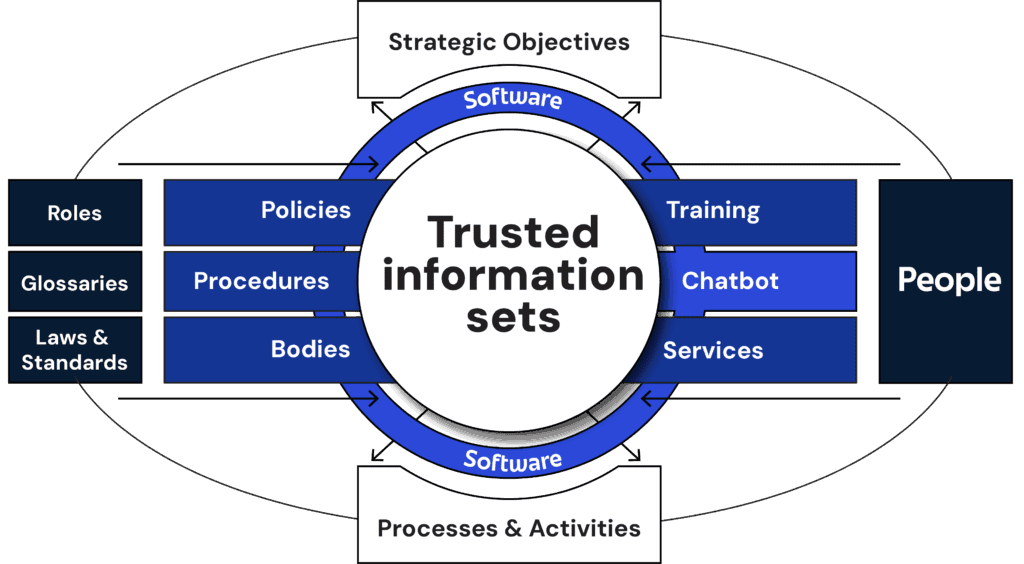
If we were to dissect a healthy infoSystem to understand how it works, we would find three inseparable sets, echoing our equation:
1. The blood: our trusted information sets
This is the circulating raw material; reliable, traceable, up to date. Just as blood carries oxygen to the muscles, these data sets feed the whole organisation. If the blood is contaminated (duplicates, false information, obsolete data), it silently spreads its errors throughout the organism, long before the first symptom appears.
2. The organs: our software
These are our applications, platforms and servers. They transmit, store and transform the infosets. Indispensable, they work like our kidneys or lungs. But beware: a tool without data is merely an organ without blood. The tool is nothing without the flow that irrigates and nourishes it.
3. The regulatory system: people, rules and language
This is the living link that unites content and container. Without it, there is no system. It brings together:
- The nervous system and the brain: our people, who take on specific Roles (such as the Document Controller or the Archivist) to pick up weak signals and act. The Bodies (our governance committees) play the part of the brain: not to control everything rigidly, but to maintain overall coherence.
- The DNA and the immune system: the DNA defines our identity and our shared language (our glossaries and standards), preventing each actor from improvising their own version of reality (the birth of silos). The immune system is made up of our governance rules, security processes and compliance measures, protecting the organism from internal drift and external attacks.
How an information ecosystem works: self-regulation
A healthy body keeps its temperature at 37 °C whether it is hot or cold outside. This is homeostasis, made possible by feedback loops.
In our infoSystem, it is exactly the same. If the quality of critical data drops or an anomaly is detected, a healthy infoSystem reacts:
- Staff detect the problem.
- The Bodies adjust the rules (Policies & Procedures).
- New training is rolled out to bring the system back into balance.
Conversely, without this regulation, that is, without governance, the system either races out of control or grinds to a halt. When it races, the result is informational chaos: data fragments, unofficial “local” files proliferate, and each team rebuilds its own version of the truth. Information overload and frustration feed on each other. Chaos becomes the norm.
Information governance: turning chaos into a durable organism
Our role at Exquando is not simply to deploy a temporary piece of software or to write a document policy that ends up in a drawer. Our role is to make sure the organism learns to regulate itself.
That is the power of the infoSystem: turning chaos into a living, intelligent and lasting organism.